


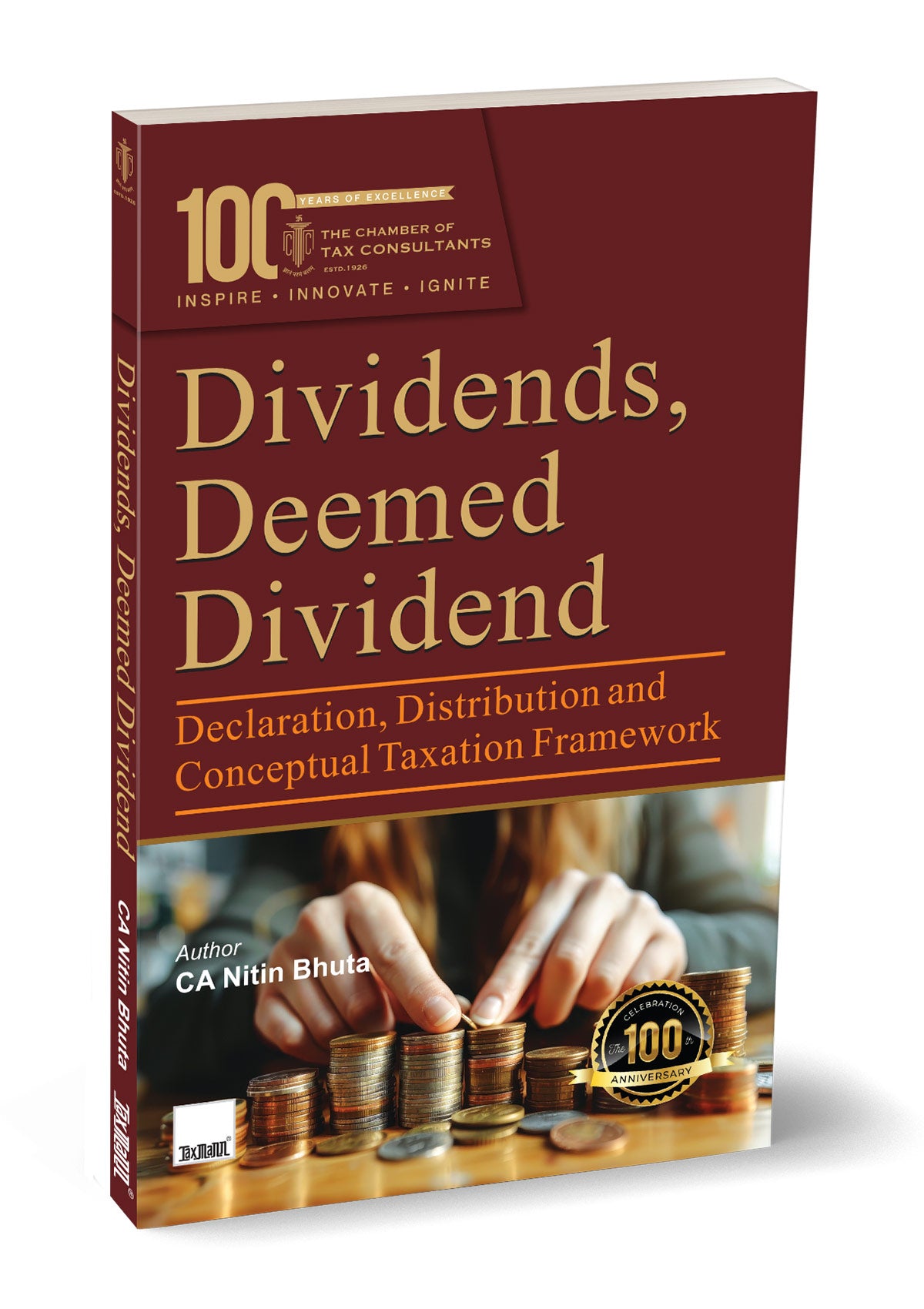
Taxmann's Dividends, Deemed Dividend (Declaration, Distribution and Conceptual Taxation Framework) - Book By Nitin Bhuta


- Rs. 315
Rs. 485- Rs. 315
- Unit price
- per
🎓 Subscribe for Free Classes & Book Reviews
Subscribe on YouTubeProduct Information
xFormat |
Printed Books |
Book Language |
English |
Faculty Name |
CA Nitin Bhuta |
Package Details |
2026 Edition. Dividends, Deemed Dividend—Declaration, Distribution and Conceptual Taxation Framework by CA. Nitin Bhuta takes a subject that ordinarily sprawls across three or four volumes and holds it in 142 pages across 21 chapters. Its organising insight is that a defective declaration under company law is the seed of a tax dispute—so Section 123 of the Companies Act and Section 2(22)/2(40) of the Income-tax Acts are read as one system, not two. Written from inside the ITA 1961 → ITA 2025 transition, it maps the old Act against the new section by section and confronts the question every practitioner is actually asking: do the old judgments still work? And it takes positions—contested questions are set out as Posers and answered with the author's own reasoned, risk-flagged view, not a hedge. Backed by a 34-page dissection of Section 2(22), a 44-point Rule 11(f) audit checklist, a 30-country DTAA table and four indices, it is a Chamber of Tax Consultants publication from Taxmann. Paperback Book. |
Item Code |
9789375619956 |
Exams |
PROFESSIONAL BOOKS |
Delivery |
Home Delivery within 7-10 days from the date of Payment Confirmation. |
Brand |
Taxmann |
Description
xTaxmann's Dividends, Deemed Dividend (Declaration, Distribution and Conceptual Taxation Framework) - Book By Nitin Bhuta
Edition : 2026
A dividend looks like the simplest transaction in corporate finance: a company earns profit, and gives some of it to its owners. That simplicity is an illusion. By the time a single rupee reaches a shareholder, it has had to survive Section 123 of the Companies Act 2013; the inclusive—and famously elastic—definition in Section 2(22) of the Income-tax Act 1961; the newly enacted Section 2(40) of the Income-tax Act 2025; a withholding obligation whose trigger point may have just moved; FEMA's Non-Debt Instruments Rules; an applicable DTAA read alongside the Multilateral Instrument; and some seventy years of accumulated judicial precedent, much of it decided on facts that no longer exist.
Dividends, Deemed Dividend—Declaration, Distribution and Conceptual Taxation Framework is CA. Nitin Bhuta's attempt—to hold all of that in a single hand. Drawing on thirty-three years of practice, the author has compressed a subject that ordinarily sprawls across three or four volumes into 142 pages of text across 21 chapters, without hollowing it out. As reviewer CA Srinivasan Anand. G. observes: 'The subject matter of a lengthy commentary running into 100s of pages in three or four volumes has been captured in a thin handy book in a concise manner.'
What makes the book distinctive is its refusal to read tax law in a vacuum. The structural insight running through it is that a defective declaration under company law is the seed of a tax dispute—so the two must be read together. The book therefore moves fluidly between the Board resolution and the assessment order, between the Register of Members and Form 27Q, between Section 52 of the Companies Act and Section 2(22)(e) of the Income-tax Act. That is how the problem actually presents itself in practice, and almost never how it is written about.
It is also, unusually, a book written from inside a transition. It does not merely note that the Income-tax Act 2025 exists—it maps it, section by section and rule by rule, against the 1961 Act, then goes further and asks the question practitioners actually need answered: do the old judgments still work? The answer given is nuanced and, importantly, hedged. Under the doctrine of continuity, precedents under ITA 1961 'would, in principle, continue to hold persuasive value' under ITA 2025—but readers are expressly advised to test each pronouncement against the revised framework before relying on it. That is a more honest position than most transition literature takes.
Above all, the book takes positions. Contested questions are framed as 'Posers' and answered with the author's own reasoned view—on whether Section 56(2)(x) is triggered on capital reduction, whether PMS fees are deductible against dividend income, whether a year-end provision for proposed dividend attracts TDS, when a dividend held up by RBI approval becomes taxable, whether Section 94(7) reaches shares acquired by gift or inheritance. Several of these views are contentious, and the author says so, flagging where a position 'is likely to be subject to scrutiny and litigation.' A practitioner can disagree with them. But they are usable—which is more than can be said of a hedge.
The book is pitched at anyone who has to make, defend, verify, or advise on a dividend decision:
- Chartered Accountants and Tax Consultants—advising on declaration, quantifying deemed dividend exposure, determining withholding, defending positions in assessment and appeal
- Advocates and Litigators—the Section 2(22) analysis is built on tracked Supreme Court and High Court precedent, indexed four ways for retrieval
- Statutory Auditors—Rule 11(f) requires the auditor's report to state 'Whether the dividend declared or paid during the year by the company is in compliance with section 123 of the Companies Act 2013.' The 44-point checklist exists to discharge precisely that duty
- Tax Auditors—direct guidance on Clause 36A of Form 3CD (deemed dividend) and its analogue Clause 48 of Form 26 under ITR 2026, including what must be reported and, pointedly, what the auditor is not required to opine on
- Company Directors and Boards—who carry the statutory obligation, and the personal exposure
- Company Secretaries and Compliance Officers—record dates, book closure, minutes, MR-3, stock exchange intimation
- CFOs and Corporate Tax Teams, especially in closely held groups where intra-group loans routinely mutate into deemed dividends
- International Tax and FEMA Practitioners—FC-GPR, FC-TRS, APR, TRC, Form 10F, beneficial ownership, POEM, MLI Article 8
- Investors, NRIs and their Advisors—dividend income, treaty relief, foreign tax credit
- Students and Academics—a coherent integrated framework rather than fragmented statutory reading
The Present Publication is the Latest Edition, commissioned by The Chambers of Tax Consultants, authored by CA. Nitin Bhuta and published exclusively by Taxmann, with the following noteworthy features:
- [Multi-disciplinary Text] Company law, tax law, FEMA and audit are read as one system. Not four subjects bolted together, but a single argument: the Articles authorise, the Board recommends, the AGM approves, the bank account segregates, the TDS crystallises, the auditor verifies, the assessee reconciles. Break the chain anywhere, and the consequences travel in every direction
- [Mapping Tables] Includes two full comparative tables—ITA 1961/IT Rules 1962 vs. ITA 2025/IT Rules 2026
- [The Core, Dissected] A 30+page forensic treatment of Section 2(22)/Section 2(40). Every sub-clause (a) through (f) is analysed for its cumulative conditions, then stress-tested scenario by scenario with the governing precedent attached
- [The Select Committee Record] Verbatim Parliamentary Select Committee proceedings on Clause 2(40). The book's most distinctive research contribution
- [Positions, Not Hedges] Contested questions posed and answered. Eleven numbered Posers across five blocks, each with the author's view, the reasoning, and, where warranted, a candid risk rating.
- [A Working Paper for Rule 11(f)] A 44-point Corporate Dividend Audit Checklist with a formal sign-off block. Segmented into Corporate Law Documentation, Income Tax Law Documentation and Any other Documentation, with Yes/No/NA, tagged document reference, and Prepared By/Reviewed By/Approved By/Working Papers Verified By. It is a working paper, not an illustration
- [Four Ways In] A 70-entry Index of Judicial Citations, Circulars and Notifications—plus an Alphabetical Judgment Index (61 judgments), a Subject-wise Index and an Income-tax Section-wise Index. Four routes into the same material
- [Thirty Treaties at a Glance] A 30-country DTAA withholding rate table, with holding-threshold conditions and allocation of taxing rights
- [Knows Its Own Limits] Demonstrates intellectual honesty about its own boundaries. The author expressly declines to litigate buy-back capital gains controversies, noting that the book 'deals exclusively with the taxation of dividends'; and concedes that cross-border dividend taxation 'could, in itself, warrant a dedicated treatise'
The coverage of the book is as follows:
- Chapter 1 — Synopsis
- A two-page map of the argument: exemption → DDT → shareholder-level taxation; the Section 123 spine; the ITA 1961/2025 comparison; deemed dividends; expense deductibility and anti-avoidance; international payouts, DTAAs and FEMA; buy-back and inter-corporate dividends
- Chapter 2 — Conceptual Framework
- Opens with the Dutch East India Company, the first public company to pay regular dividends—roughly 18% of share value annually for nearly two centuries. Under Section 123, listed, unlisted, closely held and foreign companies and OPCs may declare; LLPs and Section 8 companies are barred. Dividend policy is then read as a proxy for governance quality, contrasting professionally managed companies against closely held entities balancing distribution against tax and retention. Closes with the full arc of dividend taxation in tabular form: shareholder-taxable up to 31-3-1997 → Section 115-O DDT (10%, 12.5%, 15%, 17.65% across years) → Section 115BBDA (AY 2017-18; an extra 10% above ₹10 lakh) → Section 115R for mutual funds → today, fully taxable as 'Income from Other Sources', surcharge capped at 15%. Also flagged: dividends are specified financial transactions under Section 285BA (Section 508 of ITA 2025), making AIS/TIS reconciliation a litigation-avoidance discipline rather than a formality
- Chapter 3 — Corporate Law: Basic Provisions
- Interim dividend is declared by the Board alone; final dividend is recommended by the Board and approved at the AGM. Where profits fall short, dividends may be paid from free reserves on four cumulative conditions: the rate must not exceed the three-year average; the withdrawal must not exceed one-tenth of paid-up capital plus free reserves; the sum drawn must first absorb the year's losses; and the residual reserve must not fall below 15% of paid-up capital. Critically, these bind only free reserves—the 'Surplus' balance may be distributed without limit
- Then the Section 123 mechanics: deposit in a separate scheduled bank account within 5 days of declaration; payment only to the registered shareholder per the Register of Members; payment only in cash; disbursement within 30 days. Transfer to General Reserve is now optional, against the mandatory regime under Section 205(2A) of the 1956 Act. Non-residents trigger FEMA, the Non-Debt Instruments Rules and the FLA Annual Return—though the Companies Act prescribes no separate treatment for them. Also tested: AoA authorisation, stock exchange intimation, record-date book closure, the bar on distributing from share premium, and review of the statutory audit report and the Secretarial Audit Report (Form MR-3)
- Chapter 4 — Comparative Sections and Rules
- The two mapping tables—worth the price of admission alone for anyone advising across the changeover. Roughly forty provisions are traced: 2(22)→2(40), 8→7, 14A→14, 45→67, 56→92, 57→93, 80M→148, 94→175, 92E→172, 95→178, 139→263, 194→393, 195→393, 206AA→397, 270A→439, 285BA→508, 297→536, among others. Note also the exemptions that simply disappear: 10(34), 10(34A) and 10(35) have no counterpart under ITA 2025
- Chapter 5 — Residential Status
- A burden-of-proof asymmetry opens the chapter: Section 6(2) presumes an HUF, firm or AOP resident, with the burden on the entity (Subbayya Chettiar, SC)—but for an individual or company the burden sits with the department (Moosa S. Madha, SC). Then the 182-day and 60/365-day tests, the crew and visiting-PIO exceptions, deemed residence under Section 6(1A), and RNOR on the 120/182-day band. The Article 4 tie-breaker runs in strict sequence, stopping the moment it resolves: Permanent Home → Centre of Vital Interests → Habitual Abode → Nationality → MAP. On split residency, ITA 1961 does not recognise it within a year, but Pradeep Narasimhan (2026) draws the key distinction—the DTAA allocates taxing rights; chargeability arises under domestic law—so treaty benefits may be claimed stream-by-stream
- For HUFs, firms and AOPs, control and management is de facto, not de jure: the task is locating the 'head and brain' (Nandlal Gandalal, SC). An Indian company is resident by incorporation, with the reverse risk that control exercised abroad may create a PE or POEM there; foreign companies with turnover above ₹50 crore are tested on a POEM basis year by year—with a safeguard worth knowing: a POEM finding requires approval from a three-member collegium of Principal Commissioners/Commissioners, and the company must be heard first
- Chapter 6 — Definition of Dividend and Deemed Dividend Controversies
- The definition is inclusive, not exhaustive (Kantilal Manilal, SC), so a distribution outside the listed sub-clauses may still be a dividend. A full side-by-side of Section 2(22) against Section 2(40) follows; the verdict is that the two are pari materia, re-arranged 'to simplify the law and facilitate implementation, thereby reducing potential litigation.' Two real departures emerge. Sub-clause (d): ITA 1961 reaches only accumulated profits arising after the year ending before 1st April 1933; ITA 2025 drops the date entirely. Sub-clause (f)—the buy-back cliff—is omitted from Section 2(40) by the Finance Act 2026: paid on or before 31-3-2026 it is deemed dividend; paid on or after 1-4-2026 it is capital gains under Section 69, even if the buy-back completed earlier
- Accumulated profits are computed on commercial, not income-tax, profits: depreciation is deducted (Navnitlal C. Jhaveri); reserves are included (P.K. Badiani, SC) but provisions for taxation and dividends are not (V. Damodaran, SC); balancing charge is excluded (Urmila Ramesh, SC); tax-free income is included (Tea Estates India, SC), while capital receipts count only if chargeable as capital gains (Short Bros., SC). Assessment additions split neatly—concealed income counts, inadmissible expenditure does not
- Sub-clause by sub-clause. (a) needs both distribution out of accumulated profits and release of assets, covering kind as well as cash—'a dividend need not be distributed in money; it may be distributed by delivery of property or a right having monetary value' (Kantilal Manilal), valued at market value when entitlement arises; bonus shares to equity holders release nothing, so fall outside. (b) catches debentures and deposit certificates, and bonus shares to preference holders, despite no release of assets. (c) applies only in liquidation, and counter-intuitively bites even where the distribution does not exceed subscribed capital (Vidyutrai V. Desai). (d) carries a sharp drafting catch: unlike (f), it cites no Companies Act section, so it applies whether the reduction runs through Section 66 or Section 230—and extinguishment of rights is a 'transfer' under Section 2(47) (Kartikeya V. Sarabhai; Grace Collis, SC)
- Section 2(22)(e)—the litigation engine. Two scenarios: a closely held company lending to a registered shareholder who is the beneficial owner of shares carrying ≥10% of voting power (dividend in his hands), or to a concern in which that shareholder has a substantial interest—≥20% of equity share capital where the concern is a company, or of its income otherwise (dividend in the concern's hands). The trap most people miss: holdings in different capacities cannot be aggregated—individual and HUF capacity count separately
- More than twenty transaction types are then sorted, each with its governing precedent. Caught: overdrafts, loans in kind, layered arrangements routed on a shareholder's behalf (L. Alagusundaram Chettiar, SC), consistent debit balances, advances against property lacking immediacy (Sunil Chopra), loans funded out of exempt agricultural income—bona fide intent being no defence, since the provision bites on grant. Outside: corporate guarantees; subsidiary loans where the recipient is not a shareholder (Rajeev Chandrashekhar); genuine trade advances (Circular 19/2017); debtor–creditor dealings; business advances (Accel Ltd.); money-lending in the ordinary course; beneficial but unregistered shareholders (National Travel Services, SC); call money and share application money; and distributions out of share premium, barred by Section 52. Three further rules: an amount once taxed cannot be taxed again (G. Narasimhan, SC); repayment within the same year is no defence (Tarulata Shyam, SC); and there is no monetary threshold at all
- Tax audit interface. Clause 36A of Form 3CD (Clause 48 of Form 26) requires transaction-by-transaction reporting, cross-verified against Form 26AS/AIS/TIS. Crucially, the auditor need not opine on taxability or quantify the amount: 'the reporting requirement is factual and disclosure-oriented, not determinative of tax liability'
- Four Posers on capital reduction. Is Section 56(2)(x) triggered in the company's hands? (No, it distributes rather than receives.) Is there a recognisable capital loss? (No clarity in existing law.) Do Sections 50CA/50D apply? ('A thin interpretational boundary'.) Does Section 47(iv) exempt a holding–subsidiary reduction? (A 'genuine disconnect between section 47(iv), Section 2(47) and Section 2(22)(d)'.)
- Chapter 7 — Taxability and Issues
- The sharpest structural point in the book: Section 8 (1961) and Section 7(2) (2025) are computation provisions, not charging provisions—they govern timing, not chargeability. Declaration alone therefore creates no taxability: it 'merely reflects the intention of the company and does not confer an enforceable right unless and until it is approved by the shareholders at the Annual General Meeting' (Mafatlal Gagalbhai; J. Dalmia, SC). Interim dividend is taxed when the amount is unconditionally made available
- Three Posers, with a deliberate contrast. Where RBI approval is pending, tax falls in the later year. Where legal heirs receive unpaid dividends years later, they are not taxable in their hands; the receipt 'would partake the character of inheritance.' But a procedural lapse changes nothing: 'Procedural delays or lapses in obtaining regulatory approvals cannot, in themselves, defer the incidence of tax on such dividend income.' A substantive approval condition defers; a procedural lapse does not
- Chapter 8 — Dividend Income Characterisation
- Dividend is chargeable under 'Income from Other Sources'—invariably—whether earned by an investor, a trader or a businessman (Chugandas, SC). One page, because the answer is one sentence
- Chapter 9 — Expenses Deductible
- No deduction against dividend income other than interest—and that interest deduction, previously capped at 20% of the dividend, has now been withdrawn altogether by the Finance Act 2026. On PMS fees: not deductible, since such expenses 'cannot be regarded as commission or remuneration incurred for the purpose of realising dividend income'; a proportionate claim on the 'wholly and exclusively' test may be explored, but 'the claim is likely to be subject to scrutiny and litigation'
- Chapter 10 — Dividend Stripping
- Buying cum-dividend, selling post-record-date, harvesting exempt dividend plus a booked loss. Section 94(7)—introduced from AY 2002-03, now Section 175 of ITA 2025—disallows the loss where securities are bought within three months before the record date and sold within three months after (nine months for units). The obituary is precisely dated: efficient until 31st March 2020, then dead once dividends became taxable. A point most texts miss—the treatment is not aligned with accounting: under AS 13, dividends from pre-acquisition profits may be a recovery of cost. Shares acquired by gift, inheritance or merger ordinarily escape, there being no 'conscious purchase undertaken with the intent of availing dividend income and generating artificial losses'
- Chapter 11 — Buy-Back of Shares
- A cyclical history in four acts: capital gains under Section 45 from 1st April 1999; exempt in shareholders' hands under Section 10(34A), with the company paying 20% under Section 115QA, from 1st June 2013; deemed dividend under Section 2(22)(f), with 115QA falling away, from 1st October 2024; and capital gains under Section 69 of ITA 2025 from 1st April 2026. As the author observes: 'The taxation of buy-backs has witnessed a cyclical evolution, akin to dividend taxation—indicative of continued policy experimentation over nearly three decades'
- The NCLT analysis is the standout. Section 230(10) bars the Tribunal from sanctioning a scheme involving buy-back unless it complies with Section 68—so a scheme buy-back is a Section 68 buy-back and attracts 2(22)(f). But Section 242 has no equivalent provision, so in oppression and mismanagement petitions, purchases by other members are no buy-back at all, and purchases by the company under Section 242(2)(b)/(c) fall outside 2(22)(f)
- Two computational points are easy to miss. Under the deemed-dividend regime (October 2024 to March 2026), Section 69 deems the full value of consideration to be NIL, so the cost of acquisition produces a capital loss alongside the dividend charge. From 1 April 2026, Section 69(1) instead takes the consideration actually received into account—and the new Section 69(2) layers an additional tax on promoters, taking the total capital gains burden to 22% for a promoter company and 30% for other promoters. Also covered: the 25% ceiling on paid-up capital and free reserves; up to 10% of net worth on Board approval, beyond that by Special Resolution; mandatory extinguishment; and the three modes
- Chapter 12 — Deduction for Inter-Corporate Dividends
- Section 80M (Section 148 of ITA 2025): the deduction is available only to a domestic company, in respect of dividends received from a domestic company, foreign company or business trust and subsequently redistributed—up to one month before the Section 139(1) due date—and claimable only once on the same amount. The gross-versus-net controversy is closed by Distributors (Baroda) P. Ltd. v. UOI (SC): computed 'with reference to the gross amount of dividends received and not the net amount after deductions.' A four-company illustration walks the rule through four fact patterns
- Chapter 13 — Taxation of International Dividend Payouts
- Treaty architecture rests on Article 10, with the policy contrast made explicit: the OECD Model favours lower source-state withholding; the UN Model gives the source state more. Indicative OECD rates are 5% where the beneficial owner is a company holding ≥25% of capital for 365 continuous days, and 15% otherwise; MLI Article 8 adds holding periods to block treaty shopping
- Under FEMA, FDI and ODI are capital account transactions—FC-GPR within 30 days, FC-TRS within 60 days, APR by 31st December. But dividend remittances are current account transactions—freely repatriable, no approvals, no cap on quantum. That liberality does not excuse company law: Section 127 still mandates timely payment
- Withholding runs under Section 195 at the more beneficial of Act or treaty rate, supported by TRC, Form 10F and no-PE declarations, with Form 15CA/15CB before remittance. Mitsui Kinzoku (2026) holds that tax must be restricted to the Article 10 rate and 'any excess tax collected is liable to be refunded.' Two 2026 decisions then shift the ground: in Tiger Global (SC) a TRC, though necessary, is not sufficient in isolation—benefits must be substantiated through beneficial ownership, commercial substance and absence of treaty abuse; and in Binny Bansal, despite relocating to Singapore, the assessee was held resident in India on Centre of Vital Interests, the extended 182-day threshold being 'not automatically available'
- A live, unresolved problem. Withholding currently triggers on declaration, distribution or payment—but Section 393(2) (Entry 17) of ITA 2025 appears to trigger it on declaration alone, while FEMA permits remittance only on actual payment. The author recommends seeking CBDT clarification and staying conservative meanwhile—precisely the kind of forward-looking flag that justifies a transition-year book
- Rounding out: transfer pricing (Form 3CEB/Form 48; a 2% penalty on the value of each international transaction, plus new Finance Act 2026 fees of ₹50,000 and ₹1,00,000 for a late accountant's report); outbound ODI, where Section 80M is 'not straightforward'; and the cooperation framework (MAP, Exchange of Information). The consequence, bluntly: 'Cross-border dividend receipts are no longer passive income streams—they are actively monitored tax events'
- Chapter 14 — Withholding Taxes and TDS on Dividend
- The double-taxation objection is dismissed at the outset: a company is taxed as a separate legal entity and shareholders independently, so 'the levy of tax on dividends does not amount to double taxation'
- Mechanics: trigger at the earlier of declaration-and-approval, payment or credit; deposit by the 7th of the following month (30th April for March); returns in Form 26Q and 27Q; certificates in Form 16A. Rates: 10% to residents, on a ₹5,000 threshold under ITA 1961 and ₹10,000 under ITA 2025 for individual shareholders—no threshold for others; 20% where a valid PAN is unavailable; and for non-residents, rates in force plus surcharge and cess, with no threshold. Special rates run at 10% for GDRs and offshore banking divisions, and 20% for FII income, NRI investment income and foreign-company dividends. An operational warning worth its weight: do not deduct TDS on a deemed dividend—deduction arises only where dividends are declared and paid to shareholders
- A 30-country DTAA table runs from Hong Kong, Malaysia and Saudi Arabia at 5%, through the 10% band (Netherlands, Germany, France, Japan, UAE, Switzerland and others), to 15% (UK, Australia, Belgium, Korea), with holding-threshold conditions for the USA, Canada, Denmark, Singapore, Italy and Mauritius. An 8-step checklist covers the lower/nil deduction application under Section 395(1). Two Posers close the chapter: a year-end provision for proposed dividend attracts no TDS, no enforceable right arising until AGM approval; and where a shareholder becomes non-resident, deduction falls under Section 195, not Section 194
- Chapter 15 — Tax Jurisprudence
- Six anchor principles under the doctrine of continuity, offered as post-addition defences: stripping benefits cannot be denied absent specific anti-avoidance provisions (Walfort, SC); legitimate tax planning is not evasion (Azadi Bachao Andolan, SC); Section 14A applies across all heads (Maxopp, SC) but not absent proximate nexus; and—quietly valuable—no Section 270A penalty where the AO merely re-characterises income, or on a bona fide claim disallowed after full and true disclosure
- Chapter 16 — Corporate Dividend Audit Checklist
- Corporate Law Documentation (1–10) — AoA authorisation; Board and AGM resolutions and their minuting; stock exchange intimation; record date and closure of the Register of Members; payout through the designated dividend bank account; the bar on securities premium; deposit and debenture default; and whether the statutory auditor or Company Secretary raised any qualification, Emphasis of Matter or adverse remark (Form MR-3)
- Income Tax Law Documentation (11–35) — TDS correctness for residents and non-residents; the full non-resident document set (TRC, Form 10F, no-PE, POEM and beneficial-ownership declarations); Forms 15CA/15CB; defaults quantified as contingent liabilities and reported in CARO; transfer pricing and GAAR; reconciliation with Form 26AS, AIS and TIS; Section 80M; and sub-clause testing of 2(22)(a)–(f)—with the nice precision that item 32, on clause (f), cites only ITA 1961, since it has been deleted from Section 2(40)
- Any Other Documentation (36–44) — Whistle-blower complaints, FC-GPR/FC-TRS/APR, TCS on ODI, and stamp duty on liquidation and capital reduction
- A sign-off block — Prepared By/Reviewed By/Approved By/Working Papers Verified By, each dated—closes it. A document designed to go in a file
- Chapters 17–20 — Four Indices
- Index of Judicial Citations, Circulars and Notifications (70 entries, with forum and page reference); Alphabetical Judgment Index (61 judgments); Subject-wise Index; Income-tax Section-wise Index
- Chapter 21 — Conclusion
- The thesis restated: 'dividends are not just financial distributions but are also a reflection of good governance, corporate responsibility, and the enduring relationship between companies and their investors.' Declaration is 'not merely a financial decision but a statutory obligation'
The structure of the book is as follows:
- Statute First, Side by Side — The chapter opens with the provision, not with commentary about it. The statutory language is set out first, and where the 2025 Act has a counterpart the two are printed side by side—ITA 1961 on the left, ITA 2025 on the right—so the reader sees the drafting change rather than being told about it. This is why the sub-clause (d) date deletion, the sub-clause (e) re-ordering and the sub-clause (f) omission register as changes instead of disappearing into prose
- The Test Before the Facts — The cumulative conditions are then isolated. Before any scenario is discussed, the chapter states exactly what must be simultaneously satisfied for the provision to bite—two conditions for 2(22)(a), a specific pairing for 2(22)(b), a liquidation precondition for 2(22)(c). The reader gets the test before the fact patterns, which is the reverse of how most commentaries proceed and considerably faster to use
- Scenario Tables | Commentary as Lookup — The scenario table is the load-bearing device. The bulk of each analytical chapter is a two-column grid — Scenario on the left, Reasoning on the right, with a Judicial Support block embedded in the right-hand cell carrying the case name, full parallel citations and the deciding forum. Overdraft, loan in kind, corporate guarantee, trade advance, debtor–creditor, call money, share application money, distribution out of share premium: each is a row. A practitioner facing a specific transaction does not read the chapter—they find their row
- Posers | Flagged, Never Blended — Where the law is genuinely unsettled, the format changes deliberately. The scenario table stops and a Poser begins: the question, the author's view, the reasoning, and—where the position is exposed—an explicit risk flag. Eleven appear across five chapters, visually and structurally distinct from the settled material, so the reader always knows whether they are being told what the law is or what the author thinks it is. That separation is the book's central act of intellectual honesty
- Takeaways You Can Lift — Where a chapter has a portable rule, it closes with a short bulleted Takeaways block a reader can drop straight into a file note. Three chapters carry one: the strict-documentation rule for Section 123 (Chapter 3), the three-month/nine-month rule for dividend stripping (Chapter 10), and the domestic-company-only rule for Section 80M (Chapter 12)
- Length Follows the Litigation — Proportion is argued, not accidental. Chapter 8 runs to a single page because the answer—dividend is always Income from Other Sources—is a single sentence. Chapter 6 runs to thirty-four because that is where the litigation lives. The book spends its length where the disputes are
- Two Deliberate Exceptions — Two chapters break the template on purpose. Chapter 4 is nothing but comparative tables—no narrative at all—because its job is reference, not argument. Chapter 16 is a printable working paper with Yes/No/NA columns, a tagged-document-reference column and a four-signature sign-off block, formatted to be completed and filed rather than read
- Four Indices, Four Entry Points — A litigator enters through the Alphabetical Judgment Index; a compliance officer through the Subject-wise Index; a tax auditor through the Income-tax Section-wise Index; anyone tracking a circular through the Index of Judicial Citations. Every index carries page references into the body. The book is designed to be read front to back once, and opened at the point of need thereafter


