


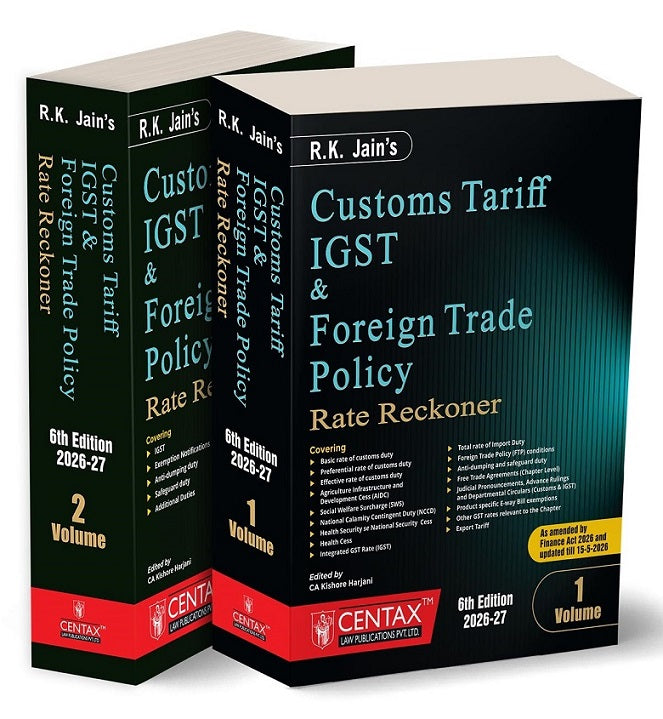
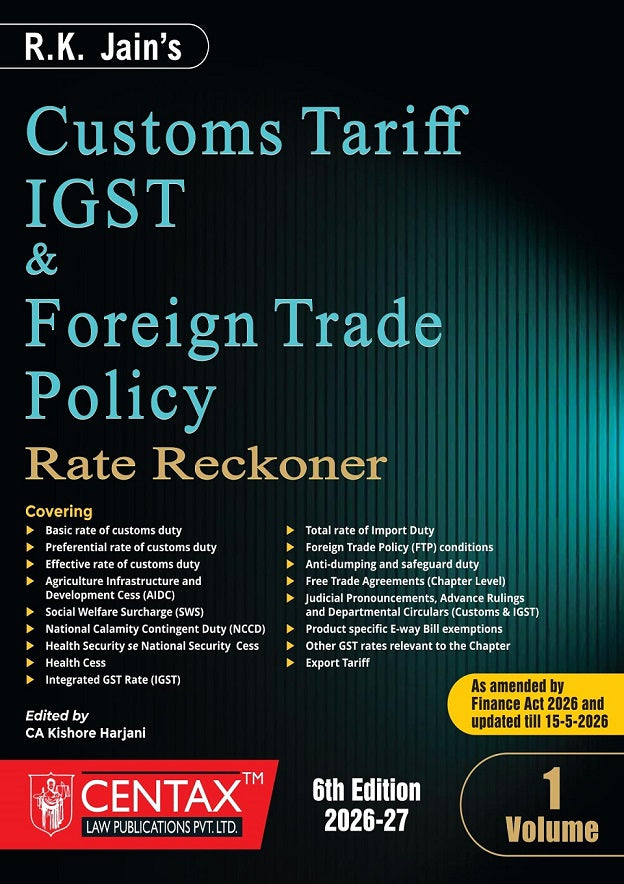
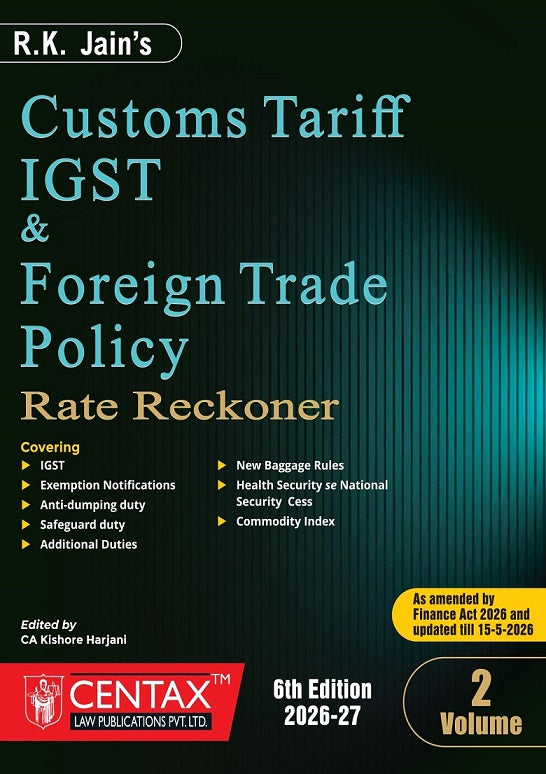
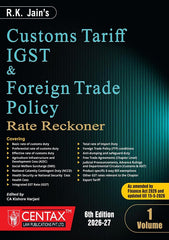
R.K. Jain's Customs Tariff, IGST & Foreign Trade Policy Rate Reckoner (Set of 2 Volumes) - Books By Centax Publications
All Products :
centax law publications
Brand : CENTAX Law Publications


- Rs. 3,069
Rs. 4,795- Rs. 3,069
- Unit price
- per
🎓 Subscribe for Free Classes & Book Reviews
Subscribe on YouTubeProduct Information
xFormat |
Printed Books |
Book Language |
English |
Faculty Name |
Kishore Harjani |
Package Details |
6th Edition (2026 - 2027). R.K. Jain's Customs Tariff IGST & Foreign Trade Policy Rate Reckoner is a purpose-built desk reckoner that collapses what is normally a four-document, four-lookup exercise into a single readable line. For every tariff item, the editorial work of running the applicable exemptions against the statutory rate is already done, so the user reads a finished position—basic, preferential, effective, surcharge, cess and IGST rates, a consolidated total import duty, and the import/export policy status—across one twelve-column row rather than reconstructing it. The set divides by function rather than subject: Volume 1 is the surface the practitioner computes from, Volume 2 the source library to verify against, the two stitched together by a disciplined apparatus of footnotes and notification cross-references that make verification a directed jump rather than an open search. Each of the ninety-eight chapters is a self-contained working unit—closing with its own trade-remedy rates, exemptions, a country-by-country FTA concordance, E-way Bill and GST notes, and relevant rulings—while an exhaustive Commodity Index routes a plain-language product name to its exact eight-digit item in seconds. This 6th Edition is amended by the Finance Act 2026 and updated with the notification and policy stream up to 15th May 2026, so the position read is the live one and not a lagged approximation. Paperback Book. |
Sold & Dispatched By |
BuyTestSeries |
Item Code |
9789349247154 |
Exams |
PROFESSIONAL BOOKS |
Delivery |
Home Delivery within 7-10 days from the date of Payment Confirmation. |
Brand |
CENTAX Law Publications |
Description
xR.K. Jain's Customs Tariff, IGST & Foreign Trade Policy Rate Reckoner (Set of 2 Volumes) - Books By Centax Publications
Edition : 6th (2026 - 2027)
R.K. Jain's Customs Tariff IGST & Foreign Trade Policy Rate Reckoner is a purpose-built desk reckoner rather than a bare reproduction of the tariff schedule, and the distinction governs everything about how it is built. In ordinary practice, arriving at the true duty cost of an imported good is not a single act of reading but an act of construction: the user must locate the heading in the tariff, run down the chain of general and specific exemption notifications to find what actually applies, carry the result across to the IGST rate schedule, factor in the cesses and the surcharge in the correct order, and then cross-check the Foreign Trade Policy to confirm the goods may be imported at all and on what conditions. Four documents, four lookups, and four opportunities for error.
The editorial proposition of this book is that all of that should already have been done, and that the user should read a finished position off one line. For each tariff item, it pre-computes the effective rate after exemptions, sets the basic rate, the preferential rate, the surcharge, the cesses, and the IGST rate alongside it, consolidates them into a single total import duty rate, and places the import and export policy status in the same row.
The two volumes are split by function and not by subject, which is the key to using them well:
- Volume 1 is the surface that a practitioner computes from
- Volume 2 is the source library that the practitioner verifies against
- The two are stitched together by a disciplined apparatus of footnotes and notification cross-references
The whole work is brought up to date with the Finance Act 2026 and the notification and policy stream up to 15-05-2026, so that the position being read is the live one and not a lagged approximation.
This publication is specifically designed for users who require precision, completeness, and speed in Customs duty computation and trade compliance, including:
- Customs and EXIM Consultants who need to state a landed-duty figure and an import or export permissibility in the same breath, defensibly and at speed, and who are answerable for the number they give
- Indirect-Tax and GST Practitioners who must carry the IGST-on-imports component through correctly, charge it on the right base, and reconcile it against the customs levies sitting beneath it
- Importers, Exporters and In-House Trade-Compliance, Costing and Procurement Teams pricing cross-border sourcing decisions, where a single misread cess can move a margin
- Customs House Agents, Brokers and Freight Forwarders working line by line through bills of entry and shipping bills under time pressure
- Customs Officers and CBIC Field Officials assessing duty and policy at the desk, who need the rate, the condition and the supporting authority in one place
- Chartered Accountants, Company Secretaries, Cost Accountants and Advocates who need not only the rate but the governing notification and the relevant ruling located together, so that an opinion or a reply can be drafted from a single open book
- Trade-Policy and Supply-Chain Analysts modelling the duty effect of a Free Trade Agreement or a sourcing shift, who need country-of-origin concessions mapped rather than hunted
The Present Publication is the 6th Edition, amended by the Finance Act 2026 and updated till 15th May 2026. This book is edited by CA. Kishore Harjani, with the following noteworthy features:
- The Single-Line Duty Position
- The duty row as the organising idea
- The heart of the book is a single twelve-column tariff line carried in every customs chapter—Tariff Item, Description of goods, Unit, Basic %, Preferential %, Effective %, SWS %, IGST %, Total %, Import Policy, Export Policy and Import Policy Remarks—laid out so that rate computation and policy clearance are read across one row rather than reconstructed from separate books
- Pre-resolved effective rates
- The editorial labour of running the applicable general and specific exemptions against the statutory rate has already been performed, so the reader consumes an effective rate instead of deriving one, while the exemption that produced it stays traceable through the footnote system rather than being silently absorbed
- A worked computation worksheet
- A fully demonstrated Total Customs Duty calculation makes the levy cascade explicit, showing not merely the rates but the base on which each component bites—the surcharge on the duty block, the IGST on value-plus-duties—so that a less specialist user can see precisely how the columns of a row resolve into a single total, and the most common practitioner error, applying a levy to the wrong base, is designed out
- The Self-Contained Chapter
- Self-contained chapter modules
- Every chapter closes with its own anti-dumping and safeguard duty rates, customs exemptions, chapter-level Free Trade Agreement position, product-specific E-way Bill exemptions and chapter-relevant GST rates, and its judicial pronouncements, advance rulings and departmental clarifications, so that a single chapter functions as a complete working unit and a user rarely has to leave it mid-task
- A genuine FTA concordance rather than a generic note
- Each chapter carries a country-by-country table—exporting country, the precise concession notification with its date, a pointer to the matching General Exemption number in Volume 2, and the nature of the benefit (reduction in BCD, exemption in BCD and/or AIDC, and so on)—which converts preferential-duty checking from a research exercise into a lookup
- A disciplined footnote apparatus
- Exemptions specific to an eight-digit item sit at the line itself; exemptions that run chapter-wide or attach at the two-to-six-digit level, together with the finer IGST distinctions such as pre-packaged-and-labelled versus loose, are carried as numbered footnotes beneath the table—a design choice that keeps the main grid uncluttered without discarding the conditions that change the answer
- Findability and Navigation
- The Commodity Index as the principal way in
- Volume 2 closes with an exhaustive alphabetical index that routes a plain-language product name to its exact tariff item, frequently to the eight-digit level and broken out by sub-variety, cross-reference and end use, so that a user who knows the goods but not the classification can still reach the right row in seconds—in practice, the index is how most working users enter the book
- Navigational engineering across 3,400 pages
- A Part-prefixed pagination scheme and running headers carrying the chapter number and title on every spread make this bulk genuinely thumb-navigable, so the physical act of finding a page does not itself become the bottleneck
- Verification Built In
- A two-way reference design
- The working rows and footnotes in Volume 1 point outward to the notifications, IGST provisions, annexures and rules-of-origin in Volume 2, so that verification is a directed jump to a known place rather than an open search, and the reader can always test a printed effective rate against its underlying authority
The coverage is organised as a deliberate division of labour between the two volumes—Volume 1 is the surface you compute from, Volume 2 is the library you verify against—and that split is what makes the set usable rather than merely complete
- Volume 1 — The Computing Surface
- Enabling text up front
- Volume 1 opens with the statutory text and interpretive rules a user needs in order to classify goods correctly and read the schedule properly, before any tariff line is reached.
- The import tariff as self-contained chapters
- It then runs the import tariff as a continuous sequence of self-contained chapters — ninety-eight chapters across twenty-one sections of the First Schedule — each presenting the twelve-column duty row, the footnotes that qualify it, and a closing module of trade-remedy rates, exemptions, FTA concordance and case law
- Export tariff to close
- The volume ends with the export tariff and its associated exemptions, completing the computing surface for both directions of trade
- Volume 2 — The Verification Library
- General import exemptions
- Volume 2 gathers the general exemptions for import that the Volume 1 chapter rows draw upon
- The full IGST apparatus
- It carries the complete IGST material—the provisions, rules, rates, exemptions and notifications—in one place for confirming the IGST component of any row
- Annexures of cesses and additional duties
- A long run of annexures collects the cesses, the additional and special duties, and the baggage, project-import and concessional-end-use rules
- Rules-of-origin instruments
- It assembles the rules-of-origin instruments for India's preferential and comprehensive trade agreements, the authority behind the chapter-level FTA concordances
- Safeguard and anti-dumping material
- The safeguard, anti-dumping and countervailing duty rules and notifications are held here for cross-reference from the relevant chapters
- Commodity Index and notification list
- At the very end sit the Commodity Index and a chronological list of basic notifications, the principal entry points into the set
- Why the Split
- Volume 2 is a destination, not front-to-back reading: The arrangement is intentional—Volume 2 is where the Volume 1 footnotes send a user when a figure, a condition or a country of origin must be confirmed against its source, and it earns its place precisely because keeping it separate lets the working volume stay lean
The structural logic of the work is repetition and predictability—a usability feature rather than a stylistic one—operating at two scales: the nine-Part spine that holds the set together, and the identical chapter template that a daily user actually works within.
- The Nine-Part Spine
- A nine-Part frame across both volumes
- The set rests on a nine-Part structure spanning the two volumes—the Customs Tariff Act text and interpretive rules, the import tariff, the export tariff, the general import exemptions, the IGST material, the annexures, the safeguard duty, the anti-dumping and countervailing duty, and the indexes—giving the whole work a fixed, predictable backbone
- The Repeating Chapter Template
- The chapter as the working unit
- Beneath the Part structure, the unit that matters to a daily user is the chapter, and every one of the ninety-eight chapters follows an identical template
- A fixed internal sequence
- Each chapter opens with the section and chapter notes and the exemptions relevant to that chapter, presents the tariff table, drops the conditional and finer-grained exemptions into footnotes immediately beneath it, and closes with the standard module of anti-dumping and safeguard rates, customs exemptions, the FTA concordance, the E-way Bill and GST notes, and the relevant rulings and clarifications
- Consistency as muscle memory
- Because the pattern never varies, a user learns the shape of one chapter and thereafter knows, without searching, exactly where each kind of information lives in all ninety-eight—the consistency turns navigation into muscle memory
- Movement at the Larger Scale
- Navigation across the full set
- The Part-based pagination, the chapter-and-title running headers and the closing Commodity Index handle the larger movements—between chapters, and across the boundary between the computing volume and the source volume—so that the structure works at both scales, the single lookup and the full cross-check


