


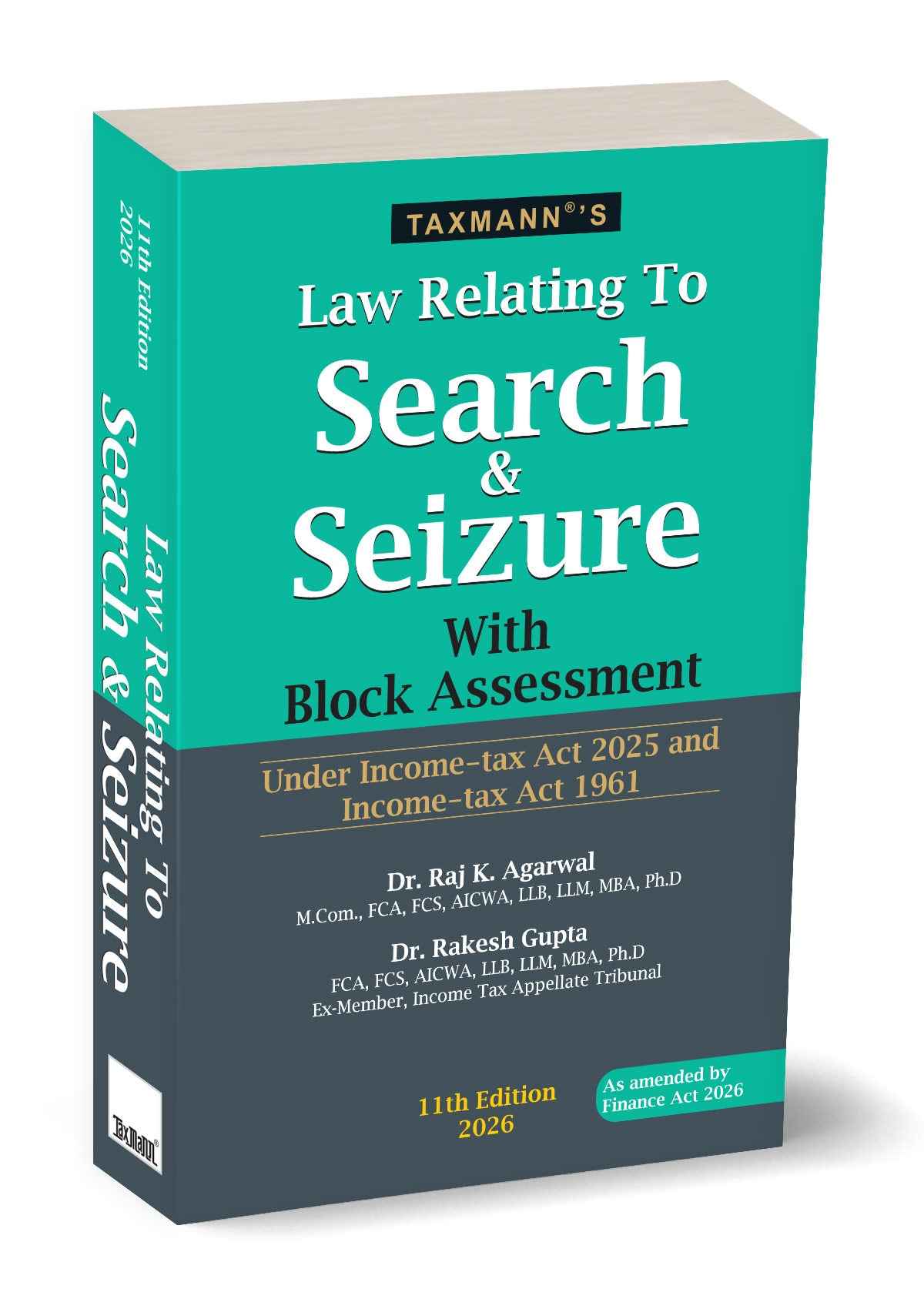
Law Relating to Search & Seizure - Book by Taxmann


- Rs. 1,977
Rs. 3,295- Rs. 1,977
- Unit price
- per
🎓 Subscribe for Free Classes & Book Reviews
Subscribe on YouTubeProduct Information
xFormat |
Printed Books |
Book Language |
English |
Faculty Name |
Raj K. Agarwal, Rakesh Gupta |
Package Details |
11th Edition (2026). Law Relating to Search & Seizure with Block Assessment is a comprehensive, practice-oriented treatise on the law and procedure of income-tax search and seizure in India—the Department's most intrusive power for unearthing undisclosed income—tracing a search from its first authorisation through conduct, seizure, assessment (including the new Block Assessment Scheme), penalties and prosecution. Its hallmark is a dual-statute architecture: the subject is rewritten around the new Income-tax Act 2025 (effective 1st April 2026), with every provision mapped section-by-section to the Income-tax Act 1961, so readers can move between the old and new law without missing a beat. Rigorous analysis of landmark Supreme Court, High Court and Tribunal rulings sits alongside genuinely usable tools—checklists, 101 FAQs, a chapter-wise case-law digest, model forms and a List of Cases with over a thousand citations. Balanced in outlook, it serves practitioners, taxpayers, administrators and students with equal authority. Paperback Book. |
Item Code |
9789364552851 |
Exams |
PROFESSIONAL BOOKS |
Delivery |
Home Delivery within 7-10 days from the date of Payment Confirmation. |
Brand |
Taxmann |
Description
xLaw Relating to Search & Seizure - Book by Taxmann
Edition : 11th (2026)
Law Relating to Search & Seizure with Block Assessment is a comprehensive, practice-oriented treatise on the entire law and procedure governing income-tax search and seizure in India—the most extreme and intrusive power available to the Income-tax Department for investigating undisclosed income. The book covers the complete life-cycle of a search action: from the conditions and authorisation that permit a search, through the actual conduct of search operations, seizure of books and assets, recording of statements, statutory presumptions, restraint orders and requisition, all the way to the assessment of search cases (including the new Block Assessment Scheme), penalties and prosecution, and the precautions a taxpayer should take before facing such action.
The defining feature of this Edition is its dual-statute architecture. The text has been thoroughly rewritten around the new Income-tax Act 2025 (operative from 1st April 2026), while deliberately retaining, section by section, the corresponding provisions of the Income-tax Act 1961. For example, the core search power is analysed as Section 247 of the 2025 Act (corresponding to Section 132 of the 1961 Act); requisition as Sections 248–249 (corresponding to Section 132A); statutory presumption as Sections 247(7) & 524 (corresponding to Sections 132(4A) & 292C); and the block-assessment machinery as Sections 292–301 of the 2025 Act (corresponding to Chapter XIV-B of the 1961 Act). Even the subordinate legislation is mapped—Rule 148 of the Income-tax Rules 2026 against Rule 112 of the 1962 Rules. This lets practitioners move fluently between the old and new law and see exactly how each provision has been renumbered and re-cast.
Beyond black-letter law, the book is unusually practical. It opens with a plethora of ready-reference tools—significant checklists, a chapter-wise digest of leading case laws on significant issues, 101 Frequently Asked Questions, and a consolidated List of Cases running to well over a thousand citations—and closes with model forms, a Panchnama proforma, the warrant of authorisation, the Taxpayers' Charter and case studies. Landmark rulings of the Supreme Court, High Courts and the Tribunal are analysed at the relevant places; where professional or judicial opinion is divided, both views are presented, and the authors offer their own considered opinion. It maintains a balanced perspective, serving taxpayers and administrators alike.
This book is intended for the following audience:
- Practising Tax Consultants, Chartered Accountants and Advocates who advise on, handle or litigate income-tax search and assessment cases
- Taxpayers—Individuals & Corporates—and Senior Corporate Executives who are facing, or want to be prepared for, a search action
- Tax Administrators & Departmental Officers needing an authoritative, well-reasoned reference on procedure and case law
- Academicians & Students of Direct-Tax Law who require a doctrinal yet practical treatment of the subject
- Anyone Needing a Working Bridge Between the Income-Tax Act 1961 & the New Income-Tax Act 2025, who must understand the renumbered provisions in context
The Present Publication is the 11th Edition | 2026, amended by the Finance Act 2026. This book is authored by Dr Raj K. Agarwal & Dr Rakesh Gupta with the following noteworthy features:
- [Dual-statute Mapping (2025 ↔ 1961)] 'Every key provision is discussed under the new Income-tax Act 2025 with its Income-tax Act 1961 counterpart flagged alongside—sections, sub-sections and even rules—making transition and comparison effortless
- [Full Block Assessment Treatment] A dedicated, thoroughly revised chapter on the Block Assessment Scheme for search cases (Sections 292–301 of the 2025 Act, i.e. the revived Chapter XIV-B regime reintroduced by the Finance (No. 2) Act 2024 and carried into the 2025 Act), spanning 18 sub-topics from 'block period' and 'total undisclosed income' to rate of tax, abatement of pending assessments, time limits and contentious issues
- [A Complete 'Assessment of Search Cases' Trilogy] The book runs all three regimes in parallel—the new Block Assessment Scheme (2024/2025), the reassessment scheme introduced by the Finance Act 2021, and the legacy Section 153A/153C regime—so every open case, past or present, is covered
- [Case-law Depth] Landmark Supreme Court, High Court and Tribunal decisions are analysed throughout, divergent views are set out fairly, and a consolidated List of Cases (well over 1,000 citations) makes the authorities easy to trace
- [Ready-Referencer] Significant checklists for handling search and assessment, a topic-wise digest of leading case laws on significant issues (organised chapter-by-chapter), 101 FAQs, and the List of Cases—designed for quick, practical answers
- [Practitioner's Toolkit] Model forms used during search, proforma of Panchnama, warrant of authorisation, the Taxpayers' Charter, ground rules for search and seizure, and worked case studies
- [Aligned with the New Criminal-law Code] Appendices reproduce the relevant provisions of the Bharatiya Nagarik Suraksha Sanhita 2023 and Bharatiya Nyaya Sanhita 2023 (which replace the CrPC and IPC), plus the Code of Civil Procedure 1908
- [Balanced Viewpoint] Issues are argued from both the taxpayer's and the department's side, with the authors candidly disclosing a modest tilt toward taxpayers given their practice background
The book is organised into 17 analytical chapters, 9 appendices, and a set of quick-reference front-matter sections. Coverage follows the natural chronology of a search action.
- Part A — Foundations & Initiation of Search
- Search and Seizure—Nature of Provisions
- Meaning of search and seizure; search vs. inspection, survey and prohibitory order; historical background; objective; features and in-built safeguards; constitutional validity; applicability of the CrPC/CPC; search powers under other economic laws and in other countries
- Circumstances When Search Can Be Initiated
- Conditions precedent; text and clause-by-clause analysis of Section 247(1); 'information in possession'; reason to believe; the grounds on which a warrant may be issued
- Authorization of Search
- Who may authorise, and the requirements of a valid authorisation
- Validity of Search—Writ Jurisdiction
- Grounds for challenging a search; who may examine validity; scope and powers of the court under Article 226; evidentiary value of material found in an illegal search
- Part B — Conduct, Seizure & Connected Powers
- Actual Conduct of Search Operations
- Powers to enter, break open, personal search, inspect electronic records, seize, place identification marks, prepare Panchnama; analysis of Rule 148 (corresponding to Rule 112); rights and duties of the taxpayer; case study of a search operation
- Seizure of Books of Account, Documents and Assets
- Restraint Order
- Sections 247(4)(b)(i) & (iii), 247(4)(b)(ii) of the 2025 Act [corresponding to Section 132(3) & (8A) of the 1961 Act]
- Recording of Statement—Section 247(6) [corresponding to Section 132(4)]
- Presumption—Sections 247(7) & 524 [corresponding to Sections 132(4A) & 292C]
- Sections 251, 247(8), 247(9), 250 & 261(a), 261(f) of the 2025 Act [corresponding to Sections 132(8)/132(10)/132(9)/132(9A)–(9D) & 132B of the 1961 Act]
- Retention of books, handling of seized assets, application of seized assets.
- Requisition—Sections 248, 249 & 261(a) [corresponding to Section 132A]
- Part C — Assessment of Search Cases
- Block Assessment Scheme of Search Cases as Introduced by the Income-tax Act 2025—Sections 292–301
- Historical background; the memorandum explaining Chapter XIV-B; block period; total undisclosed income; return for the block period (Sec. 294); assessment/reassessment; rate of tax; abatement of pending cases; set-off of unabsorbed losses; penalty; time limits; whether an in-built settlement; other contentious issues
- New Assessment or Reassessment Scheme of Search Cases as Introduced by the Finance Act 2021
- Background, memoranda, salient features, emerging issues and the relevance of earlier jurisprudence.
- Assessment of Search Cases under Section 153A/153C of the 1961 Act
- The legacy regime
- Handling of Assessment in Search Cases
- The practical playbook for the searched assessee
- Penalties and Prosecution in Search Cases
- 19 sub-topics covering Sections 271AAA/271AAB, Explanation 5A to Section 271(1)(c), the new Section 270A regime, immunity from penalty, penalties for other defaults, and offences and prosecution
- Precautions Before Facing Search Action
- Record-keeping, safeguarding evidence, vigilance regarding others, and awareness of the department's powers
- Quick-Reference Sections
- Significant checklists on various issues relating to the handling of search & assessment of search cases
- Leading case laws on significant issues
- Organised chapter-by-chapter, each issue followed by its key authorities
- Frequently Asked Questions
- 101 FAQs on practical situations (e.g., joint-name warrants, night searches, seizure of digital data, medical aid during search, time limits, the value of statements under oath)
- List of Cases
- A consolidated Table of Cases with well over 1,000 authorities
- Appendices
- Taxpayers' Charter
- Ground Rules for Search and Seizure
- Warrant of Authorisation
- Proforma of Panchnama
- Model Forms used during search
- Relevant provisions of the Bharatiya Nagarik Suraksha Sanhita 2023
- Relevant provisions of the Bharatiya Nyaya Sanhita 2023
- Relevant provisions of the Code of Civil Procedure 1908
- Extension of Time Limits due to COVID-19
The book is built in three layers so it works equally well for a two-minute look-up and for deep study:
- Quick-Reference — Before the main text, the authors place a suite of practical aids—significant checklists, a chapter-wise case-law digest, 101 FAQs, and the List of Cases—each cross-referring to the detailed chapter for fuller analysis. A reader in the middle of a live search can find an immediate, usable answer here
- Seventeen Chapters, Sequenced Like a Real Search — The chapters unfold in the order events actually occur—nature of the power → pre-conditions → authorisation → validity → conduct → seizure → restraint → statements → presumptions → consequential provisions → requisition → the assessment schemes → handling assessments → penalties and prosecution → precautionary planning.
- Within Each Chapter the Pattern is Consistent:
- The text of the provision, its legislative history, the objective/rationale, a clause-by-clause analysis, and the judicial interpretation and controversies—with the 2025 provision and its 1961 counterpart discussed side by side
- Appendices and Forms — Nine appendices supply the forms and allied statutory provisions (including the new BNSS and BNS 2023) that a practitioner needs at hand


